Saturday, 19 December 2015

Liberals hit back at spy chief Duncan Lewis over Islam calls


Liberals have hit back at ASIO chief Duncan Lewis’s phone calls to Coalition MPs urging them to use soothing language when publicly discussing violent extremism. Picture: Ray Strange

  • The Australian

  • Liberal MPs say politicians have a duty to engage in an “open and honest” debate about Islamic ­extremism, and one senator has warned that telephone calls from the nation’s top spy chief about how to talk about radicalisation could dampen free speech.


    The Australian yesterday ­revealed that ASIO director-­general Duncan Lewis had phoned Coalition MPs to urge them to use soothing language when publicly discussing violent extremism, as had been the ­approach of Malcolm Turnbull.

    Declaring the phone calls a “very unwelcome revelation”, West Australian Liberal senator Dean Smith said it was “not the behaviour” that people would expect from the head of ­Australia’s primary intelligence agency.

    “The risk is that this has a chilling effect on the ability of MPs and the community to ­exercise free speech on these matters,” Senator Smith told The Australian.

    “These sorts of things are ­better said publicly than left to operate in the shadows of the Australian community. I would argue for an honest and respectful debate about Islam and all ­religions in Australia.” Senator Smith said he had not been called by Mr Lewis.

    Victorian MP Michael ­Sukkar and Tasmanian MP ­Andrew ­Nikolic said the country could not afford to shy away from a frank conversation on ­national security and countering terrorism.

    Mr Nikolic, a former brigadier who served with Mr Lewis in the army for 30 years, said while police and security agencies were crucial in protecting the ­nation and would “always help inform policy”, MPs needed to be free to discuss confronting issues.

    Mr Nikolic said he was not one of the MPs Mr Lewis had contacted.

    “In the case of national security, our police and security agencies have a vital role to play, but it’s for members of parliament to have an open and frank discussion and people would expect us to have (that) discussion,” Mr ­Nikolic said. “We should never shy away from debates. When it comes to national security then the head of ASIO and the AFP and others are prominent voices in that debate.”

    Mr Sukkar agreed that members of parliament should be free to receive valuable advice from security experts and then “make their own judgments”.

    “I believe that we have a duty and obligation to openly and frankly discuss the big issues of our time and Islamic radicalisation is one of those that quite frankly the Australian public and our constituents expect us to speak openly about,” he said.

    Reports of the telephone calls stirred Queensland Liberal MP Andrew Laming to say it could appear as though Mr Lewis was playing politics.

    “I just note that certainly there can be briefings from security agencies and partyrooms in Canberra benefit from those intermittently,” Mr Laming told Sky News.

    “That’s by far the most helpful way of transmitting this information.”

    Some Liberals believe the Prime Minister or his office encouraged Mr Lewis’s phone calls to MPs after being impressed by a briefing he gave state and territory leaders.

    While a number of Liberals are angry at what they see as an improper intervention by Mr Lewis into legitimate political issues, others said they had no problem with the ASIO head, a former SAS commander, talking to MPs about the counter-terrorism debate.

    Mr Lewis gave an interview to Sunday papers published by News Corp (also publisher of The Australian) on Thursday last week that was widely seen as a slapdown of Tony Abbott. Two days earlier on Sky News, the former prime minister called for a religious “reformation” of Islam, although Mr Lewis did not name Mr Abbott in his interview.

    Foreign Minister Julie Bishop said yesterday it was appropriate for Mr Lewis to speak out if the debate on counter-terrorism in Australia was concerning him.

    “If the director-general of ASIO has formed the view that a public debate in Australia has the potential to hamper the work that his organisation is undertaking in relation to counter-terrorism then of course it’s appropriate for him to speak out,” she said.

    Victorian Liberal MP Dan Tehan, chair of the Parliamentary Joint Committee on Intelligence and Security, said on ABC radio that terrorism was a real threat and the director-general would have been doing what he thought was in the “best interest” of the nation.

    The Turnbull government has risked a rift over its message to Muslim Australia after a number of conservative MPs, including some cabinet ministers, criticised Grand Mufti Ibrahim Abu Mohammed’s leadership following the Paris terrorist attacks and warned of a “problem within Islam”.

    The Prime Minister has made repeated calls for greater unity with Muslim communities to defeat Islamist extremism and said a “culture of mutual respect” was essential to preventing terrorists from turning Australians against each other.

    Assistant Minister to the Prime Minister, Alan Tudge, who also said he was not phoned by Mr Lewis, declared it was “perfectly reasonable” for the ASIO head to “call whomever he likes”. “If he’s calling members of parliament, they will no doubt listen very respectfully to what he has to say,” Mr Tudge told Sky News.

    “He’s a very highly regarded figure in charge of an organisation that does exceptionally good work and those people would listen to that advice, take it on board but ultimately would make their own decisions as well.”

    Bill Shorten said it should not be up to Mr Lewis to contact Liberal MPs and ask them not to make “inflammatory comments”.

    “Malcolm Turnbull needs to rein into line the far right wing of his political party and not leave it to our security agencies,” the Opposition Leader said. “Our security agencies’ time is better spent catching terrorists and preventing crime than having to ring up recalcitrant Liberal backbenchers to explain to them the basics.”

    West Australian Liberal backbencher Luke Simpkins said he had not been contacted by Mr Lewis but would listen if he called and decide for himself what he said publicly on Islam and other issues. “I won’t be told by anybody what to say,” he said.

    Craig Kelly, a NSW Liberal MP who has called for a debate on Islamic extremism without the “tyranny of political correctness”, said he did not object to Mr Lewis ringing parliamentarians and “whispering in their ear”.

    “It’s not something that should be done publicly,” he said.

    Tasmanian MP Eric Hutchinson, who said he did not talk to Mr Lewis, said he would write his own script.

    “But if you can’t listen to people and sometimes take advice then you’re going backwards,” he said. “I think Australians are really a tolerant people and the issue for the faith is that they are having their faith misrepresented. And the Muslim faith is being misrepresented by people who are acting not in the name of Islam but they’re acting in a way that is fundamentally evil.”

    Additional reporting: Tessa Akerman, Mark Coultan

    Warren Truss office notified airport of Julie Bishop incident


    Foreign Affairs Minister Julie Bishop was reportedly singled out for a security screening.

    Phillip Hudson
    Bureau Chief
    Canberra

  • The Australian

  • Deputy Prime Minister Warren Truss’s office has admitted the government played a role in triggering an investigation into a ­botched airport screening of Julie Bishop which resulted in a security guard losing his job and two workers being suspended.


    The Foreign Minister was ­improperly singled out to be scanned on her way through Melbourne Airport to board a flight to New York on September 22.

    Melbourne Airport has confirmed that two female screeners were suspended and a male worker lost his job due to evidence Ms Bishop had not been selected randomly to be searched.

    “A male ISS worker’s employment was terminated as a result of not adhering to standard security screening as required at an Australian international airport,” the airport said.

    But the investigation occurred only after Mr Truss’s office ­referred the matter on after being “informally notified” of the incident.

    “The DPM’s office raised the matter with the department and Melbourne Airport,’’ a spokesman said last night. “Melbourne Airport undertook an investigation and acted accordingly.”

    Ms Bishop, who is one of the nation’s most frequent flyers, did not make a formal complaint.

    Her spokeswoman last night said: “The Foreign Minister passes through hundreds of airport ­security checkpoints each year and is more than happy to be treated on the same basis as other travellers.

    “Neither the minister nor anyone from her office has made any official complaint regarding her transit through Melbourne ­Airport at any time”.

    It is believed the investigation by Melbourne Airport found the security screeners did not follow normal procedure and Ms Bishop was deliberately singled out, contrary to operating protocols.

    Friday, 18 December 2015

    Bill Leak cartoon furore shows satire should have no boundaries


    Columnist
    Canberra
    Jack the Insider is a highly placed, dedicated servant of the nation with close ties to leading figures in politics, business and the union movement.
    • Jack The Insider
    • The Australian
    • December 17, 2015 1:35PM


    The Bill Leak letters page cartoon which appeared on Monday.

    The controversy surrounding Bill Leak’s ‘Aid à La Mode’ cartoon is a reminder that Australia is in danger of becoming a dry, humourless place.


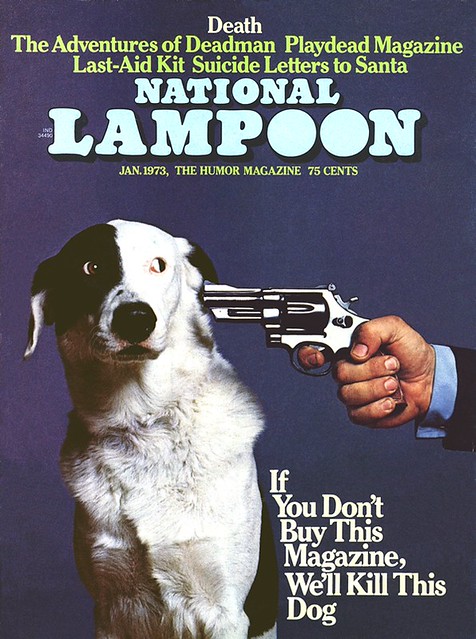
    When I was a kid, I cut my satirical teeth reading National Lampoon. The magazine was banned in New Zealand by a National Party government who feared it would corrupt young minds but in Australia it was available, not so much on the shelf but via a kindly newsagent who would put a copy aside every month provided I paid the freight.

    The magazine featured some of America’s greatest cartoonists and illustrators, Sam Gross, Gahan Wilson, Bobby London and Charles Rodriguez — to name just a few and writers crackling with madness and humour such as Chris Miller, Ted Mann, John Hughes and P.J. O’Rourke.

    No topic was off limits.

    The magazine’s covers were works of comedic art. The most famous, featured on the ‘Death’ issue in 1973, showed a man’s hand pointing a revolver at the head of a cute black and white canine with the cover line, “If you don’t buy this magazine, we’ll kill this dog.”

    The cover of the Sports edition featured a large Soviet female athlete glaring back at the camera. It was only on closer examination that it became obvious the large Soviet woman was packing something decidedly male in her athletic shorts. In Australia, we’d describe the package euphemistically as a Chiko roll and two dim sims.

    If it all sounds terribly undergraduate you’d be wrong. These days, it is the undergraduates who are hell bent on defining what is and isn’t funny and setting narrow boundaries along the lines of what’s acceptable fare for humour.

    So pervasive is it, I doubt ninety per cent of the content of National Lampoon could be published today, or if it was it would not be made available by retailers fearing some misguided boycott launched after a predictably vehement pile-on on social media.

    Early this year, comedian Jerry Seinfeld made something of a fuss in entertainment circles when he declared he would not play the US college circuit and neither would the major headline acts in US stand up, Chris Rock and Louis C.K., because college audiences were too politically correct.

    “They just want to use these words: ‘That’s racist.’ ‘That’s sexist.’ ‘That’s prejudice.’ They don’t know what the hell they’re talking about,” Seinfeld told ESPN’s Colin Cowherd.

    Sound familiar?

    I saw Seinfeld sitcom co-creator, Larry David, commence a stand-up routine with, “Say what you like about Adolf Hitler but he never took any shit from magicians,” and went on to describe how Hitler would bail magicians up backstage and under threat of state sponsored torture demand to know how the trick was performed.

    Years ago Australian comedian Steve Bedwell would sometimes start a set by saying, “My grandfather died in Auschwitz.” On cue the audience would lapse into a hush. “Yeah, he got drunk and fell out of a guard tower.”

    Analysing gags can be a tedious and subjective process, but Bedwell’s set up and punch line do not mock victims of the Holocaust. The joke is on Bedwell himself, and more broadly his audience who fall into his trap. In David’s case, gormless conjurers, almost as bad as jugglers in the live entertainment hierarchy, are the butt of the joke.

    When we look at Leak’s cartoon the butt of the joke is the developed world, represented as the United Nations for “distributing solar panels to the world’s poor because they think that provides a virtuous, if inadequate, form of electricity for which they should be grateful,” as Leak wrote yesterday.

    I saw the cartoon for the first time on Sunday night and I would have thought that was blindingly obvious but perhaps I’m an old, white, racist male and haven’t been sufficiently excoriated on Twitter to realise it.

    Anyway, this is the number one rule of comedic satire. The victim should never be the butt of the joke. Rule number two is there are no other rules.

    That should be the way it works, yet today satirical comedy is ruthlessly scrutinised for any hint of racism, sexism, xenophobia, homophobia or political bias by a generation disturbingly happy to regard easy, sanitised humour as cutting edge.

    Published in 1976, National Lampoon’s Foreigners issue was a blistering parody of Americans’ insular and inward looking view of the world. In that edition, P.J. O’Rourke’s article “Foreigners around the World” featured crude stereotypical depictions of people from all points of the compass, including Australians who he described as “violently loud roughnecks whose idea of fun is to throw up on your car.” According to O’Rourke, our national sport was “breaking furniture” and “making a shambles” was a compulsory subject of study on the primary school curriculum.

    There is no doubt that article would fail the Twitter twisted morality test. Gen X-ers would wantonly misconstrue that article as a privileged white man’s xenophobic ramblings rather than the breathtakingly brilliant parody of racism it was.

    Good satire should shock. It is meant to defy cultural sensibilities. It is supposed to make you shift awkwardly in your seat. It is likely to offend. By that measure, Bill Leak’s cartoon ticked all those boxes.

    Whether it was funny or not is a matter for personal judgment.

    The PC-brigade or anyone else must not define what is funny and what isn’t. Otherwise, before you know it, we’ll all be on a strict diet of the prat fallings of the Australia’s Funniest Videos type, which incidentally is a form of humour most popular in Germany. But don’t get me started on the Germans.

    We need publicly funded sceptics to challenge CO2 witch-hunt


    • The Australian
    In 1589, Princess Anne of Denmark left to marry King James VI of Scotland. En route, her boat was struck by storms. Someone had to be blamed and, as was standard for the time, witches were the usual suspects.


    More than 100 suspected witches were duly arrested and at least four people were burned at the stake. The fact James and Anne went on to be happily married, apparently unmolested by tempests, must have reassured them that justice had been done.

    The supposed connection between human activity and the weather is an instinctive one and perhaps helps explain the remarkable persistence of incorrect views on climate change.

    Every time there is a big cyclone a finger is soon pointed to the modern witch of carbon dioxide emissions. This continues despite there being no evidence that extreme weather events have increased because of global warming. The latest report of the Intergovernmental Panel on Climate Change admits that “evidence suggests slight decreases in the frequency of tropical cyclones making landfall in the North Atlantic and the South Pacific”.

    A significant issue with climate change science is that often only one side of the debate is heard, so clear exaggerations and untruths can remain unchallenged.

    The US military pioneered the use of so-called red teams whose job was to argue against prevailing wisdom, making its strategies more robust. Climate change science would benefit from more red team analysis.

    For example, if you listen to the mainstream media, you would not realise that since the last major attempt to forge a climate change agreement in Copenhagen six years ago, the science has become less certain and gives us less reason to worry. This is primarily because the globe’s climate seems less sensitive to increases in carbon dioxide than previously thought.

    In just the past 18 years we have experienced one-third of the increase in atmospheric carbon dioxide since the Industrial Revolution, but temperatures have not increased as expected.

    Satellite data shows no or only minimal warming, and surface-based measures show a warming rate far below projected climate models. At a US Senate hearing this week, John Christy, a lead author on previous IPCC reports, presented evidence that, on average, climate models over-estimated the rate of warming by three times compared with what actually has occurred.

    If these models cannot replicate the past, how can we rely on them to predict the future?
    The IPCC has recognised this uncertainty by winding down its estimates of how sensitive the climate is to carbon dioxide levels.

    In 2007 it reported a possible range of 2C to 4.5C, whereas last year it reported a range of between 1.5C and 4.5C. More recent evidence indicates that the figures could be even lower.

    The greatest uncertainty revolves around debates about the climate impact of aerosols in the atmosphere. A paper published this year in the Journal of Climate by Bjorn Stevens from the Hamburg-based Max Planck Institute for Meteorology argues that the impact of aerosols on climate is significantly smaller than the latest IPCC report assumes.
    Using these estimates shows that the upper bound of climate sensitivity should not be 4.5C but just 2.2C.
    That is pretty close to what we were told the world needed to avoid dangerous climate change. Readers who are paying attention will note that some green activists are now saying we need to keep warming below 1.5C rather than 2C.

    When the facts change, so can your arguments.

    Whatever the facts, too much weight is placed on conformity in climate change science — most widely demonstrated by the inane argument that “97 per cent of scientists agree”.

    Presumably 97 per cent of pundits agreed in the power of witchcraft in the 16th century.

    Science is not a democracy. Scientific knowledge progresses from the ruthless exposure of competing hypotheses to criticism. But who is doing that critique of climate change theories today?

    Public funding of climate change science almost exclusively flows to one side of the debate. Even just a small sliver of the reported $US100 billion ($139bn) fund that Paris is creating for developing countries could make a difference.

    We need red team funding of scientists who take a different view on climate change. Even if such teams ultimately take positions that are incorrect, by challenging the climate zeitgeist they would make our scientific knowledge stronger. That means the policies we implement would be based less on dogma and more on a true appreciation of how carbon dioxide emissions affect our world.

    Matthew Canavan is a Nationals senator for Queensland.


    Wednesday, 16 December 2015

    The thought police are livid about my cartoon? Now that’s funny

    BILL LEAK
    THE AUSTRALIAN
    DECEMBER 16, 2015 12:00AM
    http://www.theaustralian.com.au/opinion/the-thought-police-are-livid-about-my-cartoon-now-thats-funny/news-story/e1141c321cd25c67b81803f997d42021

    Bill Leak’s cartoon from Monday’s edition of The Australian.


    I don’t know an associate professor of sociology at Macquarie University called Amanda Wise, but she knows me. She knows me so well, in fact, that she’s not only able to tell me what my cartoons mean, but she’s also able to tell me what I was thinking while I was drawing them.
    There I was, naively thinking that if I drew a group of poor Indian people trying to eat solar panels contained in parcels sent to them by the UN anyone seeing the cartoon would assume it meant the people in it were hungry. But, no. What I thought I was thinking wasn’t what I was thinking at all. According to Ms Wise, my “unequivocally racist” cartoon drew on “very base stereotypes of third world, underdeveloped people who don’t know what to do with technology”.
    These and other startling revelations were included in an article by Amanda Meade in The Guardian on Monday. As well as being sternly reminded by the shocked Ms Wise that my cartoon would be unacceptable in Britain, the US and Canada (heaven forbid!), I was also told my cartoon was “racist” by no less an authority than Yin Paradies of Deakin University, whose research includes the economic effects of racism.
    Professor Paradies didn’t think I’d made the people in my cartoon look hungry, either, but rather, in my own twisted, racist way, I’d managed to portray not only them but the entire population of India as “too stupid to handle renewable energy”.
    I’ve been reliably informed my cartoon also triggered a hostile response from the sanctimonious but bloodthirsty mob who spend their time trawling the internet looking for anything they find offensive to provide them with an opportunity to join the orgy of competitive compassion and moral grandstanding that is Twitter.
    Such people, understandably, are probably on a bit of a high at the moment having just spent a couple of weeks watching heroic and revered climate scientists such as Leonardo DiCaprio, Sean Penn and Robert Redford spouting a series of hypocritical platitudes in Paris that culminated in world leaders signing up to an agreement to meet again in five years so they can sign another one, thereby saving the world from an impending environmental catastrophe. Again. No wonder they’re angry. First chance I get I spoil the party by reminding them that, back here, in the real world, there are billions of people who not only lack food, health, water and education, but also have no access to electricity, and more than 20 per cent of them live in India.
    And there’s something obscene about the fact that there are billions of others who’ve had all those things all their coal-power-driven lives and they’re now distributing solar panels to the world’s poor because they think that provides a virtuous, if inadequate, form of electricity for which they should be grateful. I think that’s racist, I think it’s condescending, and I think it’s immoral. But it’s also the truth, and when an impertinent cartoonist dares to tell the truth these days he’d better watch out because telling the truth is a dangerously subversive thing to do.
    It has the same ability to simultaneously shock some people while amusing others that four-letter words used to have when Lenny Bruce discovered he could use them to such devastating effect that his audiences would still be laughing while he was being dragged offstage by the police and arrested for obscenity.
    In court, Bruce argued he was being denied his right to freedom of speech, and so he was. But I can’t help thinking he had it easy, living at a time when the only people who had to stand up for their rights to freedom of speech were comedians who wanted to say f. k in public.
    And not only that, but the only people he had to worry about offending were undercover coppers in the audience whose job it was to be offended so they could arrest him for doing his job.
    These days, the undercover policemen in the audience waiting for him to swear would be the least of his worries. They’d be outnumbered 100 to one by members of the Politically Correct Thought Police Task Force, all armed with iPhones and Twitter accounts, ready to pounce the moment he said something that might not necessarily offend them but could, potentially, offend someone else.
    There’s no doubt the cartoon I drew for Monday’s paper offended a lot of people. While they might not have enjoyed looking at it, I’m quite sure they enjoyed using it as an excuse to parade their moral vanity.
    And, while I prefer to discover there are people who think my cartoons are funny, I’d be lying if I said I didn’t derive a certain amount of pleasure from discovering they enrage the ones that don’t.

    Thursday, 10 December 2015

    Queensland - Letters Patent: The Moreton Bay Courier Saturday, December 10, 1859 page 2


    Race for parliamentary positions in wake of Queensland Cabinet reshuffle

    December 10, 2015 12:00am
    Jason TinThe Courier-Mail


    Bulimba MP Di Farmer: missed out..

    JOCKEYING for plum parliamentary positions is set to begin in the wake of the Cabinet reshuffle, with snubbed MP Di Farmer potentially in line for a $20,000 pay rise.

    The appointments of Labor Unity faction member Grace Grace and Left faction member Mick de Brenni to the new-look ministry have left their previous parliamentary roles up for grabs.

    Ms Grace served as Deputy Speaker and Mr de Brenni sat as Chief Government Whip.

    Both roles come with pay packets that are more than $80,000 fatter than the base MP salary of almost $150,000.

    Party insiders anticipate the positions will remain with the Left and Labor Unity, with each nabbing one of the spots.

    Labor Unity is hoping Ms Farmer will fill one of the vacancies, given she missed out on a ministry spot.

    Unity was only able to snare one additional Cabinet position in Premier Annastacia Palaszczuk’s reshuffle, with Ms Grace taking on the Employment, Industrial Relations, Racing and Multicultural Affairs portfolios.

    Ms Farmer, a Unity member, missed out on both a ministry and an assistant ministry position.
    The Member for Bulimba is currently chair of the Finance and Administration Committee, which earns her an extra $57,000 on top of her base salary.

    An appointment to either Mr de Brenni or Ms Grace’s former positions would add more than $20,000 to Ms Farmer’s pay packet.


    Grace Grace is the new Employment and Industrial Relations Minister.

    Fellow Labor Unity MP Julieanne Gilbert currently serves as Deputy Government Whip.

    Among the names touted within the Left as possible Chief Government Whip replacements are Nikki Boyd and Chris Whiting.