Sunday, 16 October 2016

Annastacia and Adani coal mine

Annastacia Palaszczuk is a very smart parliamentarian. Her politics is subtle which contrasts with the abrasive approach of Queensland premiers past. So much so her opponents & the media often mistakenly believe she is both inactive & ineffective. 

She’s had the benefit of witnessing the mistakes of Bligh and Newman and those of Prime Ministers Gillard & Rudd. 

Where Campbell Newman would brazenly blame Labor for the problems facing the state, it is now rare in Queensland that we see Annastacia going before the media to blame any of her predecessors. 

Leading a minority Queensland government, she knows irritating miners as Rudd did with the mining tax & Gillard with carbon pricing will only give ammunition to the opposition.

The Adani Carmichael coal mine must show it is fiscally viable on its own terms. To date, it hasn't done this. 

Adani has been boasting about the venture since 2010. Where Newman was prepared to give it taxpayer money, Annastacia has ruled this out. 

Annastacia is making a political bet that Adani won't come through. In the meantime, she's building up an alternative renewable energy industry in Queensland.

Sunday, 9 October 2016

Campbell Newman admits his Queensland government got some things ‘very, very wrong’


The Courier-Mail
October 9, 2016 12:00am

CAMPBELL Newman has ­admitted the government he led got some things “very, very wrong”.

The former premier yesterday said he got the policies right but did not deliver them well. And he admitted suffering from sour grapes.

Mr Newman said he may have even survived last year’s electoral wipe-out had he acted more stealthily. A glaring example, he said, was the decision to offer voluntary redundancies in the public service.

“It was as simple as this: I got up in parliament and said this was going to happen. I was ­honest about it, I was upfront.

“If I did it being stealthy, I probably would have got away with it.”

Mr Newman was elaborating on an article he wrote for The Sunday Mail in which he warned NSW Premier Mike Baird that he too faced political oblivion if he persisted with ­decisions like banning greyhound racing, urging Mr Baird to overturn the ban.

Mr Newman said Queenslanders were upset by the pace of change after his government rocketed to power in March 2012.

“Because we did a whole lot of stuff and did it quickly … Queenslanders were presented with tales of conflict and dissent and upheaval every night on the news,” he said.

“It didn’t go down too well. In the end, people got scared.”

He accused the Queensland television networks of exaggerating the conflicts.

“Politics is about perceptions. People resented it and so they acted at the ballot box.”


Campbell Newman says Queenslanders were upset by the pace of change after his government rocketed to power in March 2012. Picture: Jack Tran
Mr Newman said his government put the economy first when many people didn’t give two hoots about the economy.

He added: “Do I have a feeling about sour grapes?

‘‘Yes, I do. I feel frustrated our mission was cut short.”

In the article, he said: “The government I led between 2012 and 2015 got some things very, very wrong.

“While I believe we pursued the right policies, we certainly got the politics, the pace of change and the communication wrong.

“But one factor from our term of government remains clear: the actions we were taking and the problems we were fixing were core platforms of our party.

“They were issues our party members and our electoral base believed in.


‘‘We just didn’t deliver them very well.”


Friday, 7 October 2016

Mike Baird plan to back down as allies warn on greyhounds ban


Former Queensland premier Campbell Newman: ‘Mike Baird is a good leader and a great Premier. This is a bad issue for him.’ Picture: Kym Smith
The Australian
12:00AM October 7, 2016
Sharri Markson
Samantha Hutchinson

Former Queensland premier Campbell Newman has urged NSW Premier Mike Baird to reverse his ban on greyhound racing, warning that the issue could cost him the premiership.

As senior Liberal sources told The Australian Mr Baird was now seriously looking at reversing the ban, Deputy Prime Minister Barnaby Joyce said he expected an open and frank discussion within the Nationals partyroom on the greyhound issue and “if changes need to be made, they should be made’’.

His comments came as Mr Baird’s former deputy and long-term NSW Nationals leader Andrew Stoner said the ban was a mistake that had cost the Baird government support in key rural areas.

Current Nationals leader Troy Grant is fighting to hold off a leadership challenge from angry MPs while Liberal sources said the backdown was being considered to save the Coalition agreement.

Mr Newman, who swept to power in Queensland on a vast majority but lost his job after three years, said left-wing animal rights groups had held too much sway over the Baird government.

He called for an end to the ban, announced in July, “because the greatest tragedy is if a competent person is not there to provide leadership”.

He called for an end to the ban, announced in July, “because the greatest tragedy is if a competent person is not there to provide leadership”.

“The alternatives are stark for the Baird government,” he said.

“Hold their ground and it will continue to gnaw away at them politically. Stick to their guns and it will hurt them, and hurt them, and hurt them.

“Or the Premier can look at some ways to actually regulate it properly. People will talk about backflips but he has the ability, the persona, to reverse this decision and effectively rebuild his and the government’s brand.

“Mike Baird is a good leader and a great Premier. This is a bad issue for him.”

Mr Stoner, who stood down as deputy premier in October 2014 and retired from politics, said the ban was hurting the government's standing ahead of a November 12 by-election in Orange in the central west where the government is fearing a savage swing.

“It’s a great shame a government with an outstanding track record on economic management and infrastructure delivery has gone so hard on an issue of relatively minor import to the state’s future, and is now in trouble electorally, particularly in Nationals seats, as a result,” he said.

Mr Grant, also the Police and Racing Minister, who was yesterday in Orange, faces an internal rebellion, with moves afoot to dump him at the Nationals partyroom meeting on Monday.

If he is overthrown as leader, the Nationals could support a Labor bill to reverse the ban on greyhound racing.

Others within the Nationals said they had considered lodging a bill to amend the legislation with a five-year extension to racing tied to a series of prescriptive targets for breeding and welfare improvements.

The bill would carry a sunset clause that would see the legislation dissolved in five years if the industry complied with the set targets.

Nationals MP John Barilaro, the Small Business and Regional Skills minister, is considered a leading rival to Mr Grant along with Local Government Minister Paul Toole and backbencher Kevin Humphries, who is considered an outside chance.

Senior Liberal sources said Mr Baird was seriously looking at reversing the ban, indicating it was not worth destroying the Coalition agreement over greyhounds.

As Queensland premier, Mr Newman took unpopular legislative decisions and lost government and his seat.

Unlike Mr Baird, Mr Newman tackled issues that were supported by the base of his party, such as budget cuts, axing 14,000 public servants and banning same-sex state-sanctioned civil ceremonies.
Mr Baird has risked political capital on left-wing issues such as protecting sharks, lockout laws and the greyhound ban.

“I think there are left-wing animal rights groups that have had far too much sway in the decisions of the government,” Mr Newman said.

He said greyhound racing was a “simple pleasure of life” for many Australians. “A lot of people like greyhounds and horse racing and trots, it’s just very Australian and very much steeped in tradition,” he said.

“ (The ban) is striking at really decent, hard-working, middle-class people, Howard-battler type people.”

Friday, 30 September 2016

Wyatt Roy reveals brush with Islamic State during Iraq visit


Wyatt Roy
The Australian
6:06PM September 29, 2016

“Look at their luck”, the soldier joked to his comrades. We’d been at his Peshmerga outpost on the frontline for no more than a minute when 15 Daesh (Islamic State) fighters kicked off a series of 50 caliber Dushka and RPG rounds from less than a kilometre away. This was not quite what I’d had in mind when I visited the Kurdistan Region of Iraq this week, as part of an extended trip to countries that I have an interest in. I was there to see a mate, get a feel for the environment, and talk to policymakers and industry leaders about their experience.

The advantage of doing an unofficial trip is the low profile — instead of getting whisked around on a whistlestop tour, you can really take the time to get out on the ground. So given a unique opportunity to access the liberated town of Sinjar, or Shingal as they call it in Kurdish, I took it, keen to see for myself the realities of Daesh’s brutality and the challenges for those remarkable people facing them down.

This wasn’t the first time I’d been in this conflict zone. When I was in parliament I’d visited the frontline with Daesh from the safety of a UN outpost in the Golan Heights in Israel, and taken part in a delegation to Baghdad. But Sinjar, and the neighbouring mountain of the same name, had an even more poignant meaning for me. This was where thousands of Yezidis were murdered and enslaved in the name of Daesh’s evil brand of Islamic extremism.

(Foreign Minister Julie Bishop has since condemned this visit.)

The unfolding atrocity caught the world’s attention, and as a then member of the government backbench I advocated in these pages for at least doubling our refugee intake as a humanitarian dividend from our strong border protection policy.

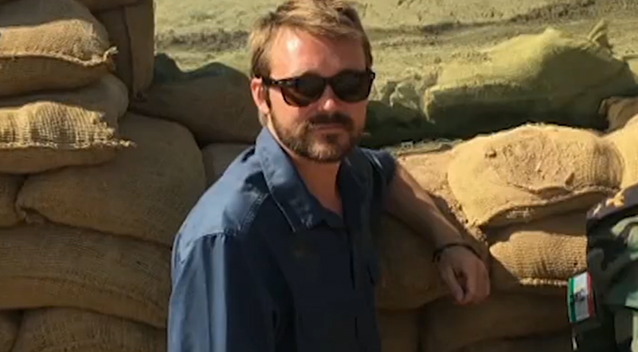
Wyatt Roy with a member of the Peshmerga in Sinjar area, west of Mosul, Iraq. Picture: Supplied
The day before we visited the Peshmerga, I’d walked barefoot through the Yezidis’ holiest temple in Lalish, inhaling the smell of olive oil burned in a tradition to bring peace to the world. A kindly old man called Ahmed took the time to explain to me some of their beliefs and traditions. He’d lived in Mosul. When I asked if he hoped to return, with a liberation expected to start at the end of this year, he simply shook his head and slowly drew a finger across his neck.

While a co-ordinated Daesh attack of the type we experienced isn’t a very common occurrence, the calmness of most of the soldiers betrayed how used to it they were. I can’t overstate how welcoming and conscientious these men were; they even took the time to pat the dust off our arms after we’d all had to hit the floor. It had been a particularly dusty day, which is probably why Daesh chose that moment, but the soldiers told us they’d still called in their position in the hope of air support. During a lull after half an hour, we were told to drive back — fast. By the time we got back to the centre of the town the sound of coalition jets already hung heavy in the air. We were later told that two strikes hit the attackers, successfully subduing the offensive.

This was a stark reminder of the crucial tactical role our air force is performing in Iraq and Syria, and it was a lesson the grateful soldiers asked me to take back home with me.

Roy in Iraq. Picture: Supplied
While we might not have had much luck that day, I now carry a greater conviction that those of us blessed to live in the “lucky country” have a moral obligation and responsibility to respond to these outrages of humanity with an assertive internationalism, not the faux security of isolationism. Few places deserve our support more than the Kurdistan Region. Up until 2014 there was optimistic talk of it becoming a new Dubai. Then in a matter of months Daesh threatened their capital, global oil prices plummeted, and then the equivalent of a third of their population sought refuge in their land.

That’s a triple-whammy not many established countries could cope with, never mind a nascent semi-autonomous region recovering from centuries of persecution. And yet, they persevere. The Kurdish people are steadfast in their resolve and aspiration for a peaceful, prosperous, and independent homeland. While facing enormous economic and political challenges, Iraqi Kurdistan offers one of the few rays of hope in a deeply sectarian Middle East. In this land of ancient religions, the government’s commitment to pluralism is undeniable — they even want see the historic Jewish population return.

Roy with members of the Peshmerga in Sinjar area, west of Mosul, Iraq. Picture: SBS
The West’s lingering “one Iraq” policy is understandable in some ways, but it no longer reflects the status quo. I believe we should not only directly support the security forces of Kurdistan but also the Kurdish people’s aspiration to build their own nation. Closer to home, Australia was prepared to take a stance like this in supporting East Timor long before the international diplomatic community came on-board with it. Why not for the Kurds? Amid the rubble in Sinjar we saw Yezidi homes tagged with black spray paint by Daesh, carrying a warning to “never enter”.

Such vivid scenes revive the increasingly distant memory of genocidal Nazism. I can only hope that we will soon be able to look into the eyes of the people of this land, and say “never again”.

Wyatt Roy was the federal member for Longman from 2010 to 2016.

Why Bishop's spiteful attack on intrepid Wyatt Roy? asks Andrew Bolt


Image result for wyatt roy iraq

Why Bishop's spiteful attack on intrepid Wyatt Roy?

Why has the Foreign Minister joined Labor in attacking Roy, a hope-to-be journalist, for checking out our Peshmerga allies in the fight against the Islamic State?
Foreign Minister Julie Bishop has blasted former colleague Wyatt Roy as “irresponsible” for travelling to the high-risk frontline of the conflict between ­Islamic State and Kurdish forces in Iraq, saying he did so “in ­defiance of government advice”.
Wow. In "defiance of government advice"? Is there a greater crime?


Mr Roy, a former front­bencher who lost his Queensland seat at the July 2 election, said ... he had been at a Peshmerga outpost on the frontline “for no more than a minute when 15 Daesh fighters kicked off a series of 50-calibre Dushka and RPG rounds from less than a kilometre away”...
“This was not quite what I’d had in mind when I visited the Kurdistan region of Iraq this week, as part of an extended trip to countries that I have an interest in,” Mr Roy said. “I was there to see a mate, get a feel for the environment, and talk to policymakers and industry leaders about their experience.”
Why not? Do we hector George Orwell for not just checking out the Spanish Civil War but fighting in it? Do we monster war correspondents who visit the front lines? Wouldn't it be good if more Australians learned - through the efforts of people like Wyatt Roy - who our allies really are in this savage and epoch-defining battle against the Islamic State?
Yet Julie Bishop joins the Twitter pack and Labor in turning feral on Roy:
Ms Bishop said Australia had banned travel to Mosul and ­official advice was “do not to travel” to Iraq.
"Advice" is a not a law. Advice is often what the Government issues just to cover its backside. I once ignored advice not to travel to Bali, and did so because I thought it wrong to give in to terrorists and make Bali suffer.

–– ADVERTISEMENT ––
“It is irresponsible of Wyatt Roy to travel to the frontline of the conflict between ISIL and Kurdish forces in northern Iraq, in a region regarded as very high risk,” she said. “He has placed himself at risk of physical harm and capture, and acted in ­defiance of government advice.
“Mr Roy did not seek nor did he receive assistance from the Australian government for his travel to Iraq. The government does not endorse or approve of Mr Roy’s actions, and strongly urges other Australians to follow the official advice of ‘Do not travel to Iraq’.
If Roy chooses to put himself in harm's way, that's his business. Thousands of Australians every day make the same kind of decisions with getting this scolding - riding motorbikes, climbing trees, trekking up steep mountains, handling snakes and crocodiles, driving too fast, riding horses, boxing and cycling in heavy traffic.
If Roy had got hurt and then asked for our help in evacuating him, then, fine, give him a lecture and the bill for his care. If he had visited the Islamic State rather than the Kurds, then let me kick him first. But this nannying is pathetic. By all means warn others of the danger, as Roy did himself, and point out that the Government won't pay for any ambulance.
But let's not start making a crime of intrepid fact-finding in a good cause. And let's drop the childish insults
“This is a very unwise and dangerous act for a former LNP member of parliament, who should be expected to know better,” the opposition’s foreign affairs spokeswoman Penny Wong said. “War zones are not places for people to act out their boyhood fantasies.”

Sunland lobbyist who owed $430,000 gave money to Stuart Robert fund


Simone Holzapfel was a former lobby­ist for Gold Coast developer the Sunland Group
The Australian
12:00AM September 30, 2016


Geoff Chambers Queensland Bureau Chief Brisbane
 @Chambersgc
Michael McKenna Reporter Brisbane
 @McKennaattheOz
A well-connected lobbyist gave more than $110,000 of her “own money’’ to the fundraising entity of federal Liberal MP Stuart Robert as her company was being wound up with unpaid debts.

Simone Holzapfel, a former longtime adviser to Tony ­Abbott, owed more than $430,000, including $355,000 to the Australian Taxation Office, when she donated $114,000 in 12 separate payments to Mr ­Robert’s “Fadden Forum’’ in mid-2013, ahead of the federal election.

Ms Holzapfel was then a lobby­ist for Gold Coast developer Sunland Group, now at the centre of the latest controversy to embroil Mr Robert, the Gold Coast MP sacked last year from the Turnbull ministry.

Months before the donations were made, Mr Robert had ­defended Sunland in parliament over its involvement in the ­detention of two Australians in Dubai, with a speech largely lifted from briefing notes supplied by Ms Holzapfel.

The notes had been sent to both Mr Robert and Mr Abbott’s chief of staff, Peta Credlin, on the morning of the November 26, 2012, speech to parliament.

It can also be revealed that Ms Holzapfel sent the notes to Mr Robert and Ms Credlin while working as Gold Coast Mayor Tom Tate’s media officer.

She left the council in February 2013 to pursue “commercial ventures’’ and reboot lobbying and PR company Shac, which had been set up in 2005.

The $114,000 donation in 2013 and Mr Robert’s bankrolling of “independent’’ candidates ahead of the Gold Coast council elections in March this year — as revealed by The Australian — are now part of an investigation by Queensland’s Crime and Corruption Commission.

Ms Holzapfel has previously told The Australian the donations were her “own money’’ and rejected suggestions she had given the money to Mr Robert’s Fadden Forum on behalf of clients.

“I ­donated because I wanted my ­former boss (Mr Abbott) to ­become prime minister, and that is my right to do,’’ she said then.

It has now been confirmed that at the time of making the donations — between July and September 2013 — Ms Holzapfel’s company was in external administration, with $437,000 in debt.
Ms Holzapfel was the sole directo­r of the company, Coolabird, which had changed its name from Shac months earlier and was eventually wound up.

Administrators confirmed yesterday that the company had debts of $437,000 when it was put into ­liquidation, including a debt of $355,000 to the ATO.

Ms Holzapfel set up a new company, Shac Communi­cations, in December 2012. She did not ­return calls yesterday.

Mr Robert yesterday described allegations that he had supported Sunland in return for donations as “incorrect and scurrilous”.

Official declarations show the Sunland Group donated more than $35,000 to the LNP at fundraising events and in donations between 2013 and last year. Mr Robert did not deny that Ms Holzapfel had ­assisted him or communicated with him about speaking in support of Sunland.

“It won’t surprise anyone to hear that a Gold Coast MP is in favour of responsible ­develop­ment,” he said.

“It’s what has built our city over many decades and it continues to be a driving force behind our enviable growth and prosperity.”

The former Australian Army officer said his parliamentary speech in 2012 about Sunland was in relation to “one-sided criticism” of the company.

The property ­developer had provided evidence against Australian businessmen Matthew Joyce and Marcus Lee, who’d been detained without trial in Dubai for almost four years.

“Following two earlier speeches delivered by a senator colleague that I also felt were one-sided, I ­believed that if one side of the issue could be aired in parliament, the other could be as well,” he said.

Earlier this year, revelations in The Australian that Mr Robert had bankrolled “independents’’ and that there were allegations of a sec­ret bloc of candidates sparked investigations by Queensland’s Electoral Commission and the state’s corruption watchdog.

Saturday, 17 September 2016

Please don’t challenge, George Christensen asks Hanson

Dawson MP George Christensen in parliament this week. Picture: AAP
The Australian
12:00AM September 17, 2016
Michael McKenna

Queensland conservative MP George Christensen appealed to Pauline Hanson not to run a One Nation candidate against him at the last election.

The Nationals whip, who this week defended Senator Hanson after her call for a ban on Muslim ­immigration, was among the few regional Queensland MPs spared from fighting a One Nation ­candidate at the July 2 poll.

Mr Christensen, who held his Mackay-based marginal seat of Dawson, said Senator Hanson raised the possibility of running a candidate against him in a phone call. “I said it would be great if they didn’t — that would be my preference … and I think they had some issues with the candidate they were considering,’’ he said.

“But, obviously, they were not looking at ousting an MP who was advocating the same sort of views espoused by One Nation.

“The views of One Nation to a degree are the views of many in the rank and file of the (Liberal National Party).’’

Mr Christensen and Senator ­Hanson got to know each other last year after both speaking at ­anti-Islam Reclaim Australia ­rallies.

“We’re not close friends, but we respect each other’s views and have a good working relationship,’’ he said.

“On a number of occasions I have shot the breeze with her, discussed various issues and found out where her interest lies in terms of policy reform.’’

This week Mr Christensen ­defended Senator Hanson’s stand against Islam after she called for a ban on Muslim immigration.

Although he said he was against a ban on Muslim immigration, he told parliament he supported a more targeted policy of banning travel from extremist hot spots.

“I think we should consider some tighter controls on borders such as restricting immigration from countries where there is a high prevalence of violent ­extremism and radicalism,” he said in parliament.