Sunday, 1 May 2016

The Van Badham eyeroll

On Sunday morning's Sunrise program, Guardian Australia weekly columnist Van Badham was attacked as a selfish anarchist feminist leftist by former federal Labor leader, Mark Latham.

Badham tried desperately to be heard about her column, "This election will be fought on class lines – not good news for Turnbull" but Latham continued to talk loudly with snide remarks.

The famous Vad Badham eyeroll gif was born.


By request, Van Badham eyeroll without Latham gif.


Latham also attacked host Andrew O'Keefe for being a leftist and feminist.

Vid of the heated moments are here.


Full 15 minute vid can be watched here: https://twitter.com/sunriseon7/status/726546626391629824


LNP spill: Lawrence Springborg faces challenge after voting blindside


Monday, 28 March 2016

Calls for Tweed Heads to turn maroon under plan for north Australian mega state


  • March 28, 2016 6:01am
  • The Daily Telegraph


NSW’s most northern township Tweed Head could become part of Queensland with its mayor saying his community would be “better off” turning Maroon.

New lines have been drawn in Queensland’s border battle, with calls for a north Australian mega state and NSW’s prized Tweed Coast to be roped into Queensland.

Premier Annastacia Palaszczuk sparked the issue, calling for Queensland to expand into northern NSW in the face of the state’s northern MPs pushing for a referendum to break away.

Turning maroon?... Tweed Heads
“There are parts of northern NSW that have more affinity with us. We should be inviting them to join us, not dividing our great state,” Ms Palasczuk said yesterday.

Tweed Shire Council deputy mayor Gary Bagnall said his community would be “better off” turning Maroon.

“In terms of distance, I would much rather be connected with Brisbane than Sydney,” Cr Bagnall said.

“The NSW Government is out of touch with our region and we would be better off governed from Brisbane. There are a lot of people in northern NSW who are very unhappy with the NSW Government.”
Momentum is growing for a mega north Australian state
NSW Premier yesterday reacted by saying: “Has April’s Fools Day come early?

“As the Queensland Premier knows there are only two kinds of peopel- those that live in NSW and those that want to.”

“In terms of distance, I would much rather be connected with Brisbane than Sydney,” Cr Bagnall said.


“The NSW Government is out of touch with our region and we would be better off governed from Brisbane. There are a lot of people in northern NSW who are very unhappy with the NSW Government.”

Sunday, 17 January 2016

Taskforce Maxima downsizing causes alarm as bikies re-emerge in club colours


  • January 17, 2016 12:00am
  • Des Houghton The Sunday Mail (Qld)

QUEENSLAND’S anti-bikie taskforce has been stripped of more than two dozen police in a move that has alarmed and mystified crimefighters.

The bikies are back, the union bosses are back, the Premier’s back & continues to hold QLD back  Picture Lawrence Springborg.
Taskforce Maxima was downsized to 85 members over the Christmas break and bikie gangs have brazenly re-emerged in club colours on the Gold Coast – at the Broadbeach dining precinct where violent clashes by gangs in 2013 led to the police crackdown. Gangs have also reappeared in Brisbane’s Fortitude Valley.

Member for Surfers Paradise John-Paul Langbroek said police could offer no explanation for the wind back. It was “absurd and dangerous”.

“The thought of them returning is petrifying,’’ he said.

New figures obtained exclusively by The Sunday Mail shows the blitz on outlaw bikie gangs has been a major success with the arrest of 2573 offenders on 8582 charges, including murder and attempted murder, grievous bodily harm, torture, extortion, kidnapping and drug trafficking, especially ice.

The disruption of the criminal gangs has led to a dramatic reduction in street violence, house breaking and car theft, and has prompted legendary crimebuster Bob Bottom to declare Maxima the most successful police operation in Australian history.

A Maxima spokesman said despite the cutbacks the taskforce was still making great strides against criminal gangs.

A video still from the 2013 Broadbeach brawl that sparked the bikie crackdown. Picture: A Current Affair
Mr Langbroek said he had disturbing reports from the Broadbeach Alliance that outlaw bikies had been spotted wearing their club colours. The alliance confirmed the sightings but declined to comment, instead planning a report to Gold Coast City Council.

Mr Bottom warned of possible political interference leading up to the release next month of a secret review of anti-bikie laws by a panel chaired by retired Supreme Court judge Alan Wilson.

The submissions have not been made public, a spokesman for Justice Minister Yvette D’Ath said.

Mr Bottom said: “Any downgrading of taskforce Maxima raises serious question marks relating to an obvious political move to dismantle Queensland’s highly successful law enforcement effort in tackling bikie gangs.”

“What is particularly concerning is that, with bikie gangs leaving Queensland because of the crackdown now under pressure to scale back, it was revealed this week that a violent new bikie group from overseas has elected to set up a chapter in Queensland.

“The gang is known as Satudarah, meaning ‘one blood’, and was founded in Holland and has a world-wide reputation for violence.”

Fortitude Valley Nightlife Association chief Nick Braban said it was a mistake to scale down Taskforce Maxima.

Police Minister Bill Byrne said the State Government would not tolerate organised crime and were adding an extra 226 police this year but did not address the reduction in Taskforce Maxima.

The violent new bikie group Satudarah is reported to be setting up shop in Queensland.

Malcolm Turnbull’s tacticians in plan to keep Prime Minister out of spotlight

  • January 17, 2016 12:00am 
  • Renee Viellaris The Courier-Mail
MALCOLM Turnbull has given Australians a great gift – a holiday from politicians.

The Prime Minister and his senior team are purposely staying out of the limelight to give voters a break from tit-for-tat battles, unless necessary.

While Mr Turnbull will be visible on the world stage with his first visit to the United States as Prime Minister, domestically the “break” will last until after Australia Day. Federal Parliament resumes for the first time in 2016 on February 2.

Opposition Leader Bill Shorten is filling the media vacuum, warning voters about everything from the Turnbull Government’s so-called plan to increase the GST to 15 per cent, cuts to paid parental leave through to health.

But Mr Turnbull and his ­tacticians have decided Australians need to enjoy the beach, barbecues and get ready for the school year without politicians crashing their holiday break.

Part of the wider political strategy is to also not “overexpose’’ Mr Turnbull, who this year will hand down his first budget, outline his plans on tax reform and ask voters to elect him for the first time in about September.

Prime Minister Malcolm Turnbull will hand down his first budget this year. Picture: Mark Evans
The plan was to give voters time off after the release of the Royal Commission into Trade Unions and Governance report but some frontbenchers have made appearances, such as Foreign Affairs Minister Julie Bishop who has provided commentary on Jakarta’s terror attacks.

Mr Shorten yesterday blasted the Government for going into “hiding” from voters on much-touted looming reforms.

``Malcolm Turnbull and his Liberals have been in hiding since the new year because they don’t want to debate issues people are worried about, like their plan to increase the GST and cut penalty rates,’’ Mr Shorten said.

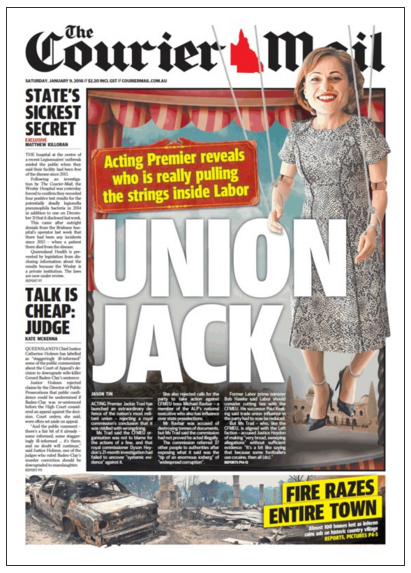
Saturday, 9 January 2016

Jackie Trad dismisses royal commission into trade unions


  • January 9, 2016 12:00am
  • The Courier-Mail


ACTING Premier Jackie Trad has backed CFMEU figure Michael Ravbar, saying Labor shouldn’t take action against the union boss because there is insufficient evidence to back the allegations against him.

In an exclusive interview with The Courier-Mail, Ms Trad also defended the CFMEU itself, saying the union as an organisation should not be punished over the actions of individuals.

“It’s a bit like saying that because some footballers use cocaine then all footballers use cocaine – it’s just not the case,” she said.

The Acting Premier also vowed the Palaszczuk Government would not reinstate the requirement for union officials to give 24 hours’ notice before entering worksites.

Labor repealed the Newman government law last year, but the report of the royal commission into trade union governance and corruption recommended it be reintroduced.

Ms Trad also slammed the inquiry as a political exercise.

Commissioner Dyson Heydon’s report was highly critical of Mr Ravbar, the CFMEU Queensland boss and ALP national executive member.

Referring to the alleged destruction of tonnes of documents, Justice Heydon wrote that Mr Ravbar “wanted the documents to be destroyed so they could not be put before the Commission”. He did not recommend criminal charges against Mr Ravbar over the document scandal, but noted that there was already a police investigation into the matter.
Acting Premier Jackie Trad has poured scorn on the union royal commission and its motivation.


Ms Trad said it was “absolutely and entirely” up to Mr Ravbar as to whether he stood down from the ALP national executive.

But she said the party should take action only when there were “allegations with sufficient evidence that warrant criminal charges”, adding: “And I haven’t seen that emerge from the royal commission.

“Quite frankly, there is insufficient evidence as far as I can see,” she said.

“The commission didn’t recommend criminal charges be laid and this has been ... a very heavily politicised royal commission from the outset.

“So I think it needs to be viewed from that perspective as well.”

The Acting Premier and influential Left faction figure also defended the CFMEU, saying the union had not been charged “as an organisation”.

“The organisation as a whole, just because of a couple of individuals, shouldn’t be completely punished,” she said.

Ms Trad stressed that anyone found to have committed criminal offences should “face the full force of the law”.

But she was adamant that CFMEU should not be punished because of the actions of individuals, saying there was no “systemic evidence” of corruption against the union.

Ms Trad described the inquiry as the “baby” of the federal Coalition Government and a political extension of it, while accusing Justice Heydon of making “very broad, sweeping allegations ... allegations that actually didn’t have sufficient evidence to back them up”.

“Quite frankly (Justice Heydon) can opine all he likes – maybe he should opine in front of LNP or Liberal Party functions as opposed to sitting on the bench at a royal commission,” she said.

Ms Trad says there is insufficient evidence against former CFMEU state secretary Michael Ravbar.

Asked whether the state would adopt the commission’s recommendation that laws be introduced requiring union officials to give 24 hours’ notice before entering worksites, Ms Trad said the Government would reject the proposal.

“The Palaszczuk Government made very clear, in Opposition and in the lead-up to the last election, that we would bring back world-class workplace health and safety laws in this state and we won’t be repealing those laws,” she said. “We have made a commitment and we will continue to maintain a commitment not to wind back any safety provisions, any workplace conditions and entitlements that Queensland workers enjoy, regardless of what Tony Abbott’s politicised commission says.”

Ms Trad suggested the commission should have spent time hearing about “sham contracting and those workers who wanted to blow the whistle on unsafe work practices that many companies are actually presiding over in this nation”.

Former prime minister Tony Abbott earlier this week defended the establishment of the inquiry as “the right and decent thing to do” in an opinion piece in The Australian.

Tuesday, 5 January 2016

Jamie Briggs case: ministerial standards must be reviewed


  • JENNIFER ORIEL
  • THE AUSTRALIAN 
  • JANUARY 5, 2016 12:00AM
Illustration: Eric Lobbecke

The resignation of Jamie Briggs for breaching ministerial standards during a night out in Hong Kong with public servants raises serious questions about the standards and the process for investigating noncompliance.

Malcolm Turnbull signed off on the Statement of Ministerial Standards last year. The statement covers legal guidelines common to management and shareholder groups.

However, it also includes standards related to appropriate ministerial behaviour that lack clarity, appeal to due process and explicit reference to relevant legislation. Such obscure standards provide ample opportunity for abuse of process.

The finding against Briggs is that he breached ministerial standards, but the Prime Minister has not clarified publicly which standards were breached.

Briggs has conceded his behaviour constituted an “error of professional judgment”, but such an ambit admission generally would be deemed insufficient to warrant resignation from a plum political post. The ambiguity has left many questions unanswered, leading to public criticism of Briggs, the consular staff member who complained about him and government handling of allegations.

The investigation into Briggs raises questions about the quality of ministerial standards as well as procedures governing them. On the information made public, the complaint appears to have been classified incorrectly, leading to a disjuncture between proper procedure, investigative processes and natural justice.

According to reports in The Weekend Australian, the consular staff member reported that Briggs had commented on her “piercing” eyes, placed his arm around her and kissed her on the neck. Briggs claims instead that he had told another person in the bar the staff member had “beautiful eyes”, placed his arm around her when posing for a photograph and gave her a goodnight kiss on the cheek.

As with many such allegations, there are no independent witnesses to verify which is the more accurate version of events. In normal professional circumstances, such allegations would be managed under standard sexual harassment procedure. Like any procedure, it can be abused, but it provides greater legal recourse for abuse of process than the ambiguous guidelines for interpersonal behaviour found in the ministerial standards.

Some members of the governance subcommittee with responsibility for assessing the outcome of the investigation into Briggs expressed concern to The Weekend Australian about it.

They believe ministerial standards have been set impossibly high. They are right to be concerned, but the chief problem is not high standards for ministerial behaviour. It is the obscure nature of the standards and the procedure for investigating breaches of them.

I managed complaints procedure in the education sector, writing harassment and discrimination procedures in compliance with federal and state legislation. There are set stages established in good complaints processes to provide transparency and natural justice to both complainants and respondents. The case against Briggs presents problems at the earliest stage because the complainant allegedly chose not to lodge a formal complaint, requesting instead that her concerns be resolved informally by direct communication to him. In such a case, an employer may still choose to take action if they deem the threat of vicarious liability significant enough to warrant it or internal standards have been breached.

Generally speaking, however, such standards must be related explicitly to legislation to give effect to such serious remedies as the public reprimand of an employee and his resignation.

It is unclear why Turnbull and his advisers chose to manage the informal complaint about Briggs under the ministerial standards rather than procedural instruments related explicitly to the relevant legislation. The ministerial standards do not provide clear procedural steps for the classification, management and resolution of complaints about ministerial behaviour related to allegations of unwelcome sexual advances or harassment.

On the information available, the government appears to have handled poorly the allegations about Briggs. However, the apparent mismanagement may be less a consequence of the Turnbull administration in general than the ministerial standards in particular.

Successive Liberal and Labor administrations have sought to redress the problems with ministerial standards and codes of conduct. A 2012 paper on codes of conduct provided analysis of the predominant concerns in Australian and overseas parliaments.

They include unclear parameters for behaviour, a lack of independent oversight in complaints investigations and a limited range of penalties for breaches of ministerial standards. All are relevant to the complaint about Briggs.

The allegations about Briggs may not have been made formally, but they have produced official consequences. The lack of a proper complaints-handling process leaves complainants and ministers in a precarious position.

It is in the interest of both the Liberal and Labor parties to review the ministerial standards or replace them with guidelines for professional behaviour related explicitly to the law.

Jennifer Oriel is a political scientist and commentator.